


This article was first published on Croakey Health Media.
Australia’s national football codes and clubs are saturated with sponsorship from alcohol and gambling companies, whose brands adorn team uniforms, are prominent in stadium advertising and are promoted through the clubs’ digital channels, a new report has found.
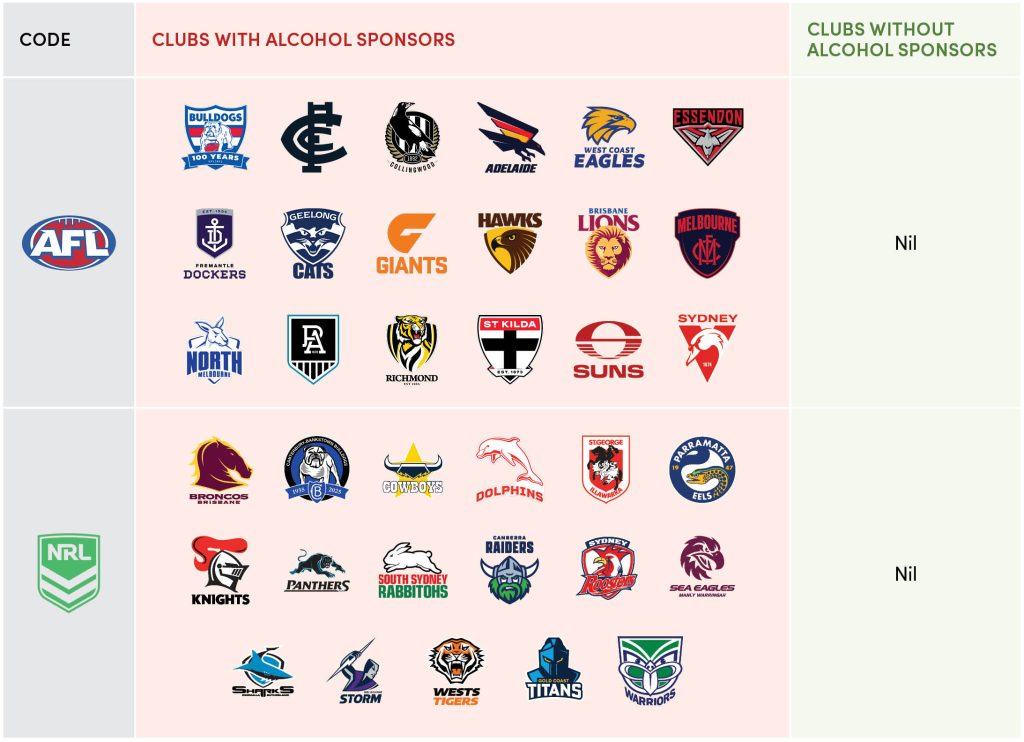
The report, State of Play: Alcohol and gambling industry influence in the AFL and NRL, has found that every Australian Football League (AFL) and National Rugby League (NRL) club is sponsored in some way by alcohol companies.
The AFL and the NRL are also making money from every bet placed on their games under deals with sports betting companies.
This is reported to amount to $50 million per year for the NRL and $30-40 million per year for the AFL, raising serious concerns for conflicts of interest and the ability of these leagues to effectively consider harm when they are directly profiting from peoples’ gambling losses.
The State of Play report, commissioned by the Foundation for Alcohol Research and Education (FARE), examines AFL and NRL clubs, league and TV broadcast deals with alcohol and gambling companies in 2025 and up to May 2026.
It reveals the extent of alcohol and gambling company sponsorships of national men’s and women’s football codes, the AFL/AWFL and NRL/NRLW clubs, leagues, and television broadcast partnerships.
The report finds that, as part of AFL alcohol sponsorship deals in 2025 and 2026, all AFL clubs advertise alcohol brands at stadiums during matches, and all AFL clubs promote alcohol brands through their digital channels.
Two AFL clubs, Brisbane Lions and St Kilda, had alcohol branding on playing or official uniforms in 2025, but this was discontinued for both clubs in 2026.
Over the same period, at least 12 NRL clubs advertised alcohol sponsors at stadiums during games, while all NRL clubs promote alcohol brands through their digital channels.
Five NRL clubs (Brisbane Broncos, Canterbury Bankstown Bulldogs, Dolphins, Newcastle Knights and North Queensland Cowboys), have alcohol branding on their playing or official uniforms.
The alcohol sponsorship of one club, the Manly Warringah Sea Eagles, involves home stadium naming rights.
Rising reach and influence
Meanwhile, all NRL clubs, and five AFL clubs, are sponsored by gambling companies.
The sponsorships of NRL clubs include sports gambling and lottery brands, casinos and poker machine clubs, under deals in place in 2025 and 2026.
Deals with NRL clubs for branding on players uniforms and gambling stadium advertising or in-match promotion increased from 2025 to 2026.
This is notable given the Australian Government has introduced new legislation to Parliament proposing banning wagering advertising content in sport venues and on players’ and officials’ uniforms, prohibiting using sports players or celebrities in wager advertising content, and reducing broadcast TV gambling advertising.
Five AFL clubs – Brisbane Lions, Fremantle, Gold Coast Suns, Greater Western Sydney (GWS) Giants and West Coast Eagles – had sponsorship deals with gambling brands, including sports gambling companies and casinos, in 2025 and 2026.
The report shows that alcohol and gambling companies are integrating themselves with the AFL and NRL, and using their reach and influence to gain extensive advertising exposure through direct sponsorships of clubs and leagues, and partnerships with TV broadcasters.
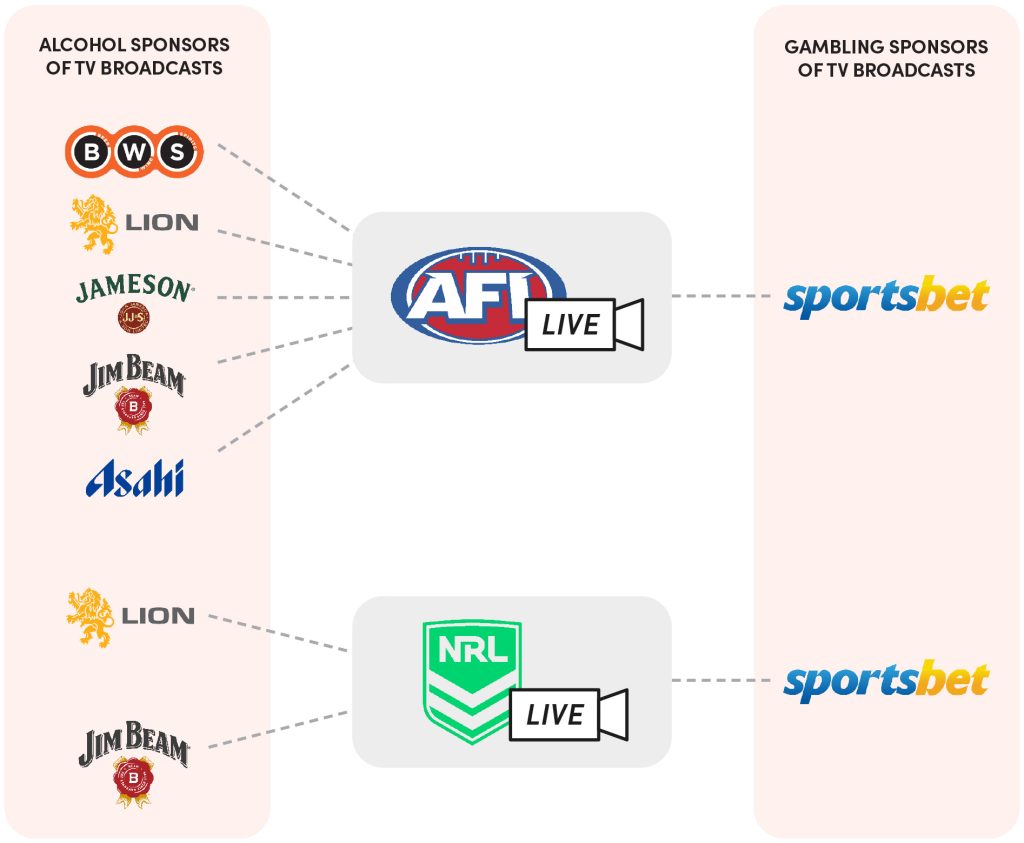
Alcohol and gambling partnerships with free-to-air TV broadcasters are also increasing – highlighting the urgent need for reforms to current loopholes in Australia’s regulation of television advertising.
A small number of parent corporations are behind more than half of all AFL and NRL alcohol and gambling sponsorship deals.
Harms for women, children
Children are exposed to alcohol and gambling advertising through attending sports and watching sports on television. Due to major regulatory gaps and loopholes, alcohol and gambling advertising can be shown on commercial TV during live sports broadcasts, when high numbers of children are watching.
Children’s exposure to alcohol marketing is linked to using alcohol at a younger age and at higher levels. Likewise, exposure to gambling advertising influences children and young people to adopt positive attitudes to gambling and increases their risk of gambling harm.
Alcohol and gambling are known to fuel and exacerbate violence, including to women and children. Research also shows that women and children are at higher risk of violence during sports broadcasts.
Research has also found that alcohol and gambling companies target those most at risk of harm through their marketing. We know that 10 percent of Australians consume over half of all alcohol, and that Australians have the highest per-capita gambling losses in the world.
Many AFL and NRL women’s teams also have alcohol and gambling sponsors, providing new avenues for these companies to target young women.
Sponsorship announcements for the 2026 season indicate that alcohol and gambling sponsorships of AFLW and NRLW teams will increase in 2026, extending the reach of alcohol and gambling advertising to young women.
Close the loophole
The number of alcohol sponsors of AFL and NRL free-to-air TV broadcasting partnerships has increased from 2025 to 2026 through new deals with Seven and Nine which will increase the volume of alcohol advertising during NRL and AFL matches on free-to-air TV this year.
These benefit from a sports loophole which means alcohol advertising is allowed on televised sport anytime on weekends and public holidays, in an exemption to the rules that typically mean alcohol advertisements cannot be shown when children are likely watching.
The Australian Media and Communications Authority (ACMA) is currently reviewing the Commercial TV Industry Code of Practice, which sets out these rules, to assess whether it adequately protects community members from harm.
The fact that a loophole allows harmful ads to reach children shows the current rules are failing to protect the community.
ACMA has the power to close the sports loophole and create a new standard for television broadcast advertising that puts people’s health first.
Dr Belinda Townsend is Research Lead and Dr Aimee Brownbill is Policy and Research Manager at the Foundation for Alcohol Research and Education.